
Why Florida is strict about this
The Florida Department of Health states that drowning is the leading cause of unintentional death for Florida children ages 1 to 4. It says Florida ranks 5th in the nation for drowning deaths, well above the national average, that more than 500 Floridians died from unintentional drowning in 2023 alone, and that home swimming pools are where most children are likely to drown.
A barrier doesn't replace watching children. What it buys is time: a gate that closes and latches on its own, and a fence a toddler can't climb, slip through or crawl under, stand between a child who wanders out of the house and the water.
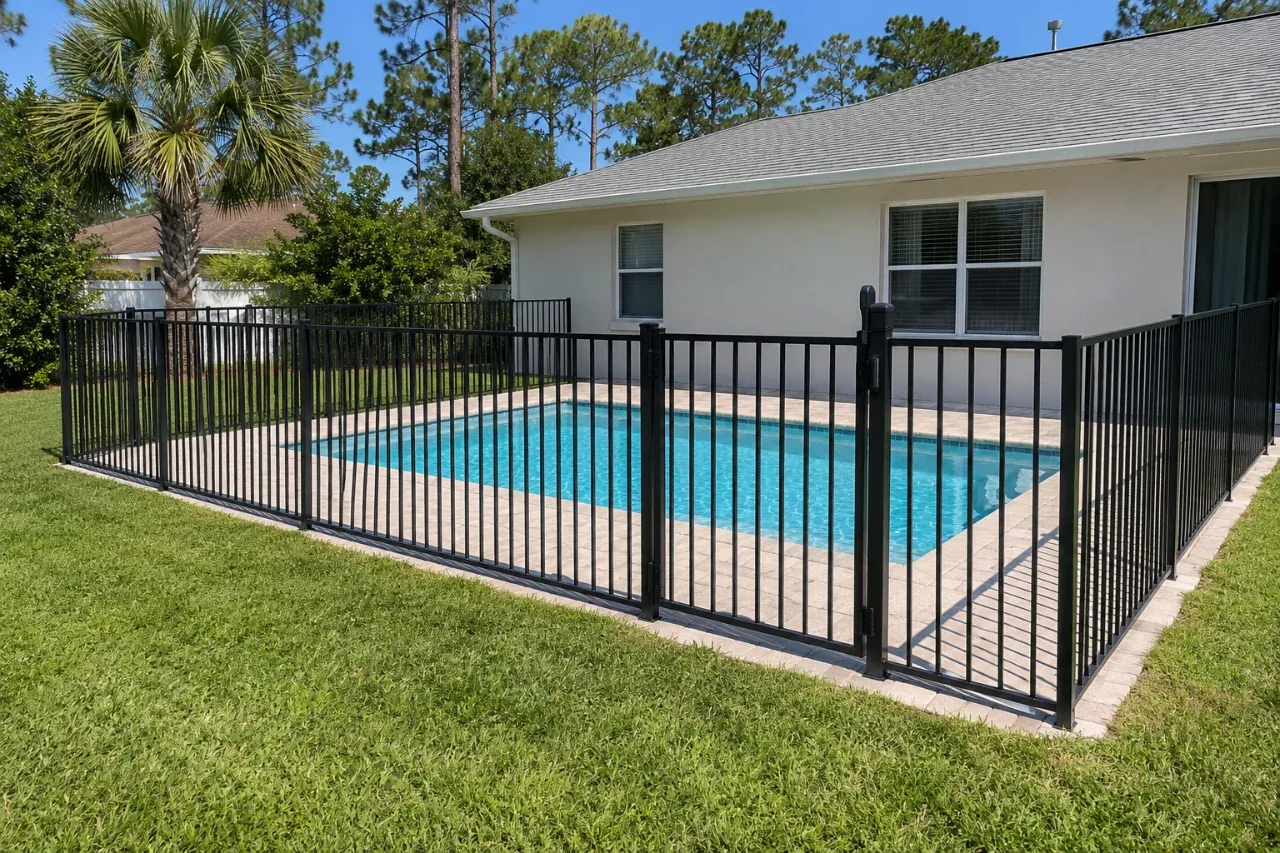
What a new pool must have
Under section 515.27 of the Florida Statutes, a new residential pool has to have at least one of these before it can pass final inspection:
- An enclosure that meets the state's pool barrier requirements and isolates the pool from the home.
- An approved safety pool cover.
- Exit alarms on every door and window that opens directly onto the pool area, rated at least 85 decibels at 10 feet.
- A self-closing, self-latching device on every door that opens directly onto the pool area, with its release at least 54 inches above the floor.
- A pool alarm that sounds when someone enters the water, independently certified to ASTM F2208. Wearable alarms don't count.
Leaving a new pool without one of these is a second-degree misdemeanor under the same section, unless, within 45 days after being cited, the person adds a required feature and attends a drowning prevention program. A fence is the option on that list that works without anyone remembering to arm an alarm or close a cover.
What the barrier law requires
Section 515.29 sets the barrier rules. In plain terms:
- Height: at least 4 feet, measured on the outside.
- No way through, under or over: no gaps, openings, indentations, protrusions or structural parts that would let a young child crawl under, squeeze through or climb over.
- Distance from the water: far enough from the edge that a child or a frail elderly person who gets past it can't fall straight into the pool.
- Gates: open outward, away from the pool; close on their own; and latch on their own with a locking device. The release goes on the pool side, where a young child can't reach it over the top or through a gap.
- The house wall can be one side of the barrier only if no door or window in it opens onto the pool area. If one does, the door and window alarm or latch options above come into play.
- Above-ground pools: the pool's own wall can be the barrier, or a barrier can sit on top of it, if it meets the same rules. A ladder or steps have to lock, come off, or sit inside a compliant barrier.
The building code's details
The Florida Building Code, Residential (the 2023 8th edition is in force through 2026) carries the detailed barrier measurements in section R4501.17, and Seminole County's pool safety affirmation, for example, cites that section. Engineering Express, a Florida engineering firm, summarizes the familiar numbers this way. Treat them as a summary and let the inspection decide:
| Item | As summarized |
|---|---|
| Height | At least 48 inches |
| Openings | None that pass a 4-inch sphere |
| Gap at the bottom | 2 inches at most |
| Horizontal rails under 45 inches apart | On the pool side, with pickets no more than 1.75 inches apart |
| Chain link mesh | 2.25 inches at most |
The gate latch has its own rule. The code's gate section, R4501.17.1.8, as quoted from the 2017 edition in a Florida Building Commission declaratory statement (DS 2019-071), calls for a self-latching device "located on the pool side of the gate." The release may sit on either side only where it is at least 54 inches above the bottom of the gate, and the gate and barrier may have no opening wider than 1/2 inch within 18 inches of the release. Confirm the current edition's wording with the inspector.
The rail rule is the one people miss. Horizontal rails close together make a ladder, so they belong on the inside of the fence, where a child outside can't use them as steps.
Fence types used around pools
Aluminum
Thumbtack's pool fence guide gives one pro's example of 4-foot black aluminum at about $20 per linear foot installed, and $21 to $25 with custom arched gates. In Palm Coast, aluminum fences may be black, bronze or white. Picket spacing is the detail to confirm. See aluminum fences.
Vinyl
Solid vinyl panels leave nothing to climb if the rails face the pool. Thumbtack says glass pool fences cost the most, followed by vinyl or iron. Vinyl colors must meet the city's standard. See vinyl fences.
Mesh barriers
Removable mesh safety barriers have their own section of the building code, R4501.17.1.15, which Seminole County's affirmation lists as a separate option. Ask whether the company you call installs mesh barriers.
Screen enclosures
Many Florida pools sit inside an aluminum screen enclosure, and an enclosure that meets the building code can serve as the barrier. That's enclosure work, not fence work, and in Palm Coast screen enclosure repairs and rebuilding need a building permit before work starts, according to the city's 2024 storm advisory.
How it fits Palm Coast's rules
A pool fence is still a fence under the city code. It needs the owner's signed acknowledgement, can't stand past the front of the house, and stops at 6 feet in side and rear yards. On a saltwater canal lot, a fence within 20 feet of the water is held to 4 feet unless it's open, but a fence enclosing a pool deck may reach 6 feet if it's set back at least 7.5 feet from the side lines and 15 feet from the water.
The pool itself goes through the city's permit and inspection, and the barrier is part of what gets checked. If you're adding a pool, ask the pool builder whether the fence has to be up before the final inspection and who is setting it.
Pool fence cost
Thumbtack's pool fence page (updated October 22, 2026) gives a national range of $1,001 to $3,929. Its general fence cost page (updated July 1, 2026) gives a wider $2,500 to $10,000 for pool fences. The two pages measure differently and don't agree, and neither is a Palm Coast price. Self-closing hinges and a code-height latch are the parts of the gate worth asking about line by line.
What goes wrong
- A gate that swings in. The law says outward, away from the pool.
- A latch a child can reach from outside, over the top or through the pickets.
- A climbable side: rails on the outside, a planter, a pool pump or a chair against the fence.
- A gap under the fence where sand has washed out after rain.
- A house door left out of the plan when the house is one side of the barrier.
- A gate propped open. Self-closing only works if nothing holds it.
Questions homeowners ask
Does an existing pool need a fence?
Section 515.27 applies its requirements to new residential pools at final inspection. For an older pool, the Department of Health's message stands on its own: home pools are where most young children drown.
Can my screen enclosure count as the barrier?
If it meets the building code's enclosure requirements, yes. Ask the inspector or the enclosure builder, since screen damage or an unlatched door changes the answer.
How tall should a pool fence be?
At least 4 feet on the outside under state law, and no taller than the city allows where it stands: 6 feet in side and rear yards, 4 feet near saltwater unless open or a qualifying pool-deck enclosure.
Which way should the gate open?
Outward, away from the pool, with a self-closing, self-latching device.
How this site helps: your request goes to one independent local contractor who builds pool fences. This site doesn't inspect barriers. The building inspector does.
Related guides
Sources
- Florida Department of Health, Water Smart FL; drowning prevention, last modified September 4, 2026.
- Florida Statutes 515.27 and 515.29, 2026.
- Seminole County pool safety affirmation, citing the 2023 Florida Building Code, Residential, R4501.17.
- Engineering Express, fence design overview, updated April 24, 2025.
- Florida Building Commission, declaratory statement DS 2019-071, quoting R4501.17.1.8 of the 2017 Florida Building Code, Residential.
- Thumbtack, pool fence cost, updated October 22, 2026; fence installation cost, updated July 1, 2026.
- City of Palm Coast, fence regulations sheet; post-storm advisory, October 10, 2024.