
No permit, but a signed acknowledgement
The City of Palm Coast's October 10, 2024 post-storm advisory says it plainly: "Residential fences do not require a permit." The same advisory adds that new or replacement fences "do require an acknowledgement to be signed by the property owner," and that a residential fence must conform to the city's location, height and allowable style rules.
The city's fence regulations sheet describes the acknowledgement as the owner acknowledging the city's Land Development Code before the fence goes in. The acknowledgement is signed by the owner, not the contractor, so the rules below are worth knowing before you sign. A contractor can help you with the form. Ask the Building Division at (386) 986-3780 for the current form, or check the city's permit portal.
The city's permit search lists fence records. Our November 6, 2026 count of that search found 604 from January 1 through November 5, 2026, roughly 60 a month across the city.
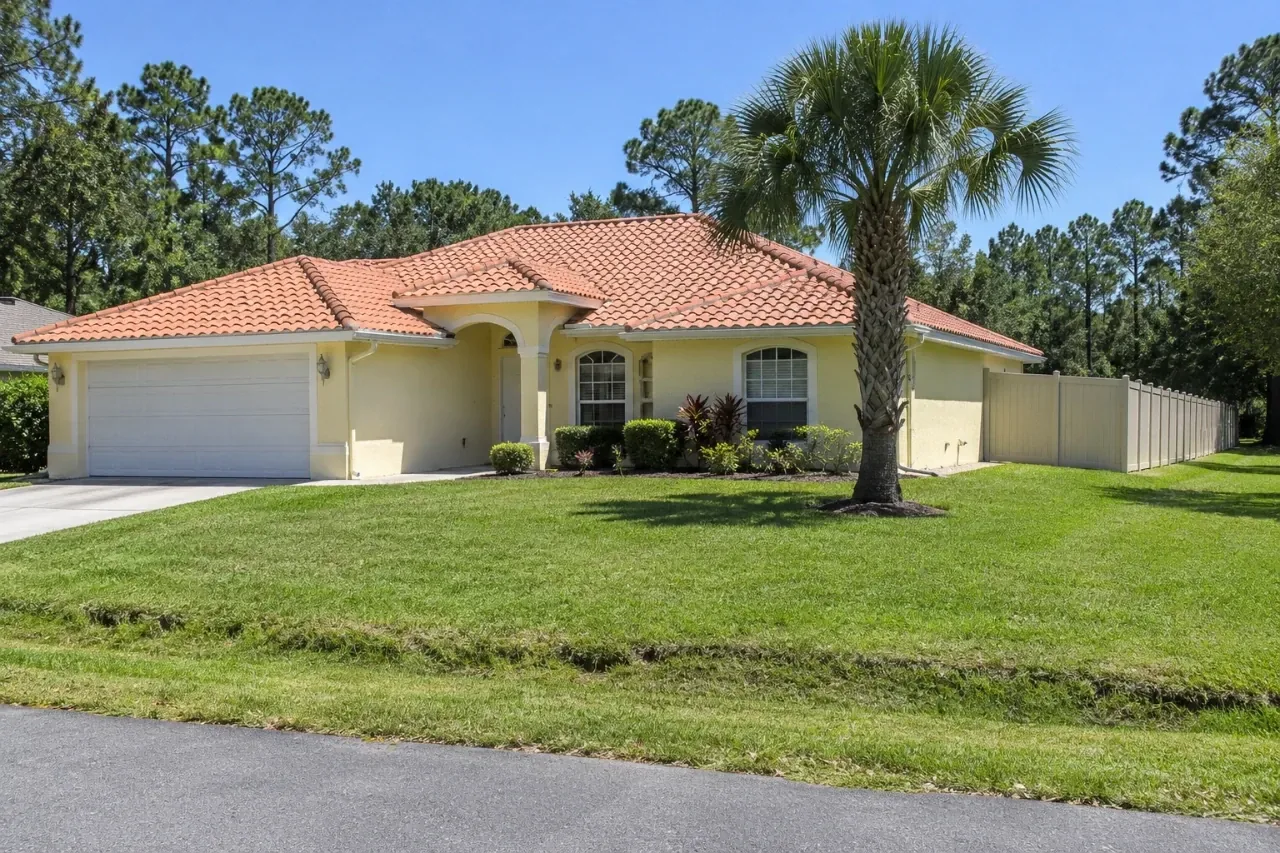
Where a fence can stand
The city's sheet, which excerpts Land Development Code section 4.01.02 (fences) and section 9.02.02 (easements), sets these location rules:
- Not past the front of the house. Fences may not extend beyond the front facade. Only homes in the AGR, EST-1 and EST-2 districts may have front-yard fences.
- Property lines are allowed, except on front and street-side lot lines, where the fence has to meet the zoning district's setbacks.
- Finished side out. Fences go in "with the finished side facing the exterior of the property," so the neighbors and the street see the good side.
- Gates stay on your side. A gate may not swing onto a neighboring property, and double gates or gates wider than 6 feet next to a right-of-way are prohibited.
- Stormwater ditches and canals: the fence sits behind the top of the bank, on the owner's side.
- Drainage: a fence may not interfere with drainage.
- A survey is recommended to confirm where the line really is.
The gate rule matters on corner lots. If you were hoping for a wide double gate on the street side to pull a boat or trailer into the back yard, ask the Zoning Division at (386) 986-3751 before the posts go in.
How tall it can be
| Where | Limit |
|---|---|
| Interior side and rear yards, behind the front facade | 6 feet |
| Rear yard within 20 feet of a saltwater waterway | 4 feet; an open fence may reach 6 feet |
| Pool deck enclosure at least 7.5 feet from the side lines and 15 feet from the saltwater waterway | 6 feet |
| EST districts, in front of the front facade or in a street-side yard | 4 feet |
| Decorative columns and architectural trim | Up to 12 inches above the limit |
Height is measured from finished grade. The sheet says grade may not be raised to gain height, and a berm under the fence counts toward the total. Canal lots have their own guide.
Materials the city allows and bans
- Parts in contact with the ground have to be rot-resistant. Treated lumber may be left unfinished.
- Chain link, aluminum other than decorative aluminum, and similar fences are prohibited in yards that front arterial or collector roads.
- Chain link may not carry slats, fabric or screening.
- Barbed wire, razor wire, electrified fences, broken glass, and steel spikes or other sharp tops are prohibited.
- Chicken wire and field fence are prohibited, except for genuine agricultural use in the AGR and EST-2 districts.
Colors
The city judges color by light reflectance value, or LRV, a number paint and fence makers publish for each color. Light pastels and white need an LRV of 80 or higher. Earth tones need 25 or higher. Fluorescent colors, purple, fuchsia, magenta and orange are prohibited, except orange used as a pastel accent, and so are loud, clashing or garish colors.
Metal fences follow a simpler rule. The sheet says chain link, aluminum and similar metal fences "shall be black or bronze in color," and that aluminum may also be white. Vinyl has to meet the city's color standard in section 13.02.06.B.1, or use a wood-grain finish in an allowed color. If you're choosing a stain or a vinyl color, ask the maker for its LRV.
Easements: allowed, at your risk
A fence may go in an easement as long as it doesn't interfere with the utilities there. The catch is in the next line of the city's sheet: the utility that needs access may remove the fence, and the owner pays to replace it. FlaglerLive's July 2015 report on the council's first-reading approval of this rule described it the same way. Before you run a fence down an easement, it's worth asking what's buried there and how often it gets dug up.
PEP panels and swales
About half of Palm Coast homes had a PEP tank, short for pretreatment effluent pumping, when the city's communications manager gave that figure to the Palm Coast Observer in 2017. The tank's control panel hangs on the outside of the house. The city's fence sheet asks that a fence sit at least 3 feet behind the PEP panel so the Utility Department can reach it.
Palm Coast streets drain through grassy swales and stormwater ditches. Keep the fence out of them, and keep dirt and sod out of them while the posts go in: the sheet warns that dumping materials, dirt or sod into ditches, swales or canals can bring fines from Code Enforcement and the Florida Department of Environmental Protection. Ditch placement questions go to Engineering and Stormwater at (386) 986-4750.
Shrubs in front of some fences
The fence sheet points to Chapter 11 of the code, which calls for landscaping along street sides, saltwater canals and golf courses: plants spaced 3 feet on center, 3-gallon size. Open-style fences, such as chain link, are exempt. On a corner lot with a solid privacy fence along the side street, budget for that hedge row.
If trees come out for the fence, the sheet says the lot has to keep or replant one tree per 2,500 square feet, or major fraction of it. Protected trees have their own permit rules, so ask the Building Division before cutting.
HOAs
The city's sheet says homeowners associations and other architectural rules may be stricter than the city code, and that owners have to get their approval separately. City approval doesn't stand in for HOA approval, and HOA approval doesn't stand in for the city's rules.
Call 811 before the posts go in
Sunshine 811, Florida's call-before-you-dig center, says installing a fence requires a call and that it's the law. Call at least two full business days before digging. Sunshine 811 doesn't mark lines itself; its member utilities send locators to mark theirs.
Outside the city limits
These rules are the City of Palm Coast's. Unincorporated Flagler County, Bunnell and Flagler Beach set their own. Call Flagler County Growth Management at (386) 313-4003, Bunnell Community Development at (386) 437-7516, or Flagler Beach at (386) 517-2000 and press 3 for the Building Department.
Questions homeowners ask
Can a fence go right on the property line?
Yes, except on front and street-side lines, where the district setbacks apply. A survey keeps it from ending up on the neighbor's side.
Can I add privacy slats to my chain link?
No. The city's sheet says chain link may not have slats, fabric or screening.
Does replacing an old fence need the acknowledgement too?
Yes. The city's advisory says new or replacement fences need the owner's signed acknowledgement.
Is a pool fence handled differently?
A pool barrier has to meet Florida's pool safety law as well as the city's height and location rules. See pool fences.
How this site helps: your request goes to one independent local fence contractor. This site doesn't interpret the code for your lot. The Zoning Division does.
Related guides
Sources
- City of Palm Coast, fence regulations sheet (excerpts of LDC 4.01.02 and 9.02.02), undated, read November 2026.
- City of Palm Coast, Hurricane Milton post-storm advisory, October 10, 2024.
- City of Palm Coast, Building Division; permit search, counted November 6, 2026.
- FlaglerLive, July 8, 2015.
- Palm Coast Observer, PEP tanks, September 9, 2017.
- Sunshine 811, homeowners, read November 2026.
- Flagler County Growth Management; Flagler Beach Planning and Building, read November 2026.