
The season and the record
The National Hurricane Center puts the Atlantic hurricane season at June 1 to November 30, with the peak around September 10 and most activity from mid-August to mid-October.
Palm Coast has been tested. When Hurricane Matthew passed on October 7, 2016, the National Weather Service in Jacksonville measured hurricane-force gusts at Flagler Beach, up to 83 mph, estimated gusts of 76 to 80 mph north of Palm Coast, reported trees uprooted in Palm Coast by noon, and recorded a 6-foot storm surge depth in a Palm Coast saltwater canal. The Palm Coast Observer later reported about $72.8 million in private property damage countywide, including about $3.6 million in Palm Coast across 195 single-family homes and 7 multifamily buildings. After Hurricane Milton in October 2024, the city issued the storm advisory quoted below.
Solid fences and open fences
A privacy fence is a wall the wind can push on. Engineering Express, a Florida engineering firm, explains that solid privacy fences have low porosity, so wind pressure builds against them and stresses the structure, while open designs such as pickets let wind pass through and reduce pressure and the risk of damage. That's the trade at the heart of a Palm Coast fence: the privacy you want is the surface the wind loads.
The same firm notes two things that matter in a storm. Soil may be saturated during a design wind event, and compaction is typically neither required nor measured when fences are built. It also reports that many designers consider a fence that leans in high wind but stays intact to be properly designed. A fence that leans and stays together is something you fix; one that lets go of its posts becomes debris.
What holds a fence up
A fence's strength is in its posts. This Old House's post guide (updated May 22, 2026) recommends:
- Holes about one-third the post's height plus about 6 inches for gravel, and deeper in loose soil.
- Crushed stone in the bottom for drainage, and gravel mixed into compacted backfill in loose ground.
- A concrete footing for end posts and gate posts.
- Closer spacing, 4 to 6 feet, at corners and high-stress spots, against 6 to 8 feet for ordinary line posts.
For wood, the American Wood Protection Association lists posts in ground contact at Use Category 4A or higher. A post that has rotted at the ground line gives up its strength right where the wind load is greatest. When you read a quote for a privacy fence, the post details are the place to look. See the hiring guide.
Choosing with wind in mind
- Need privacy? Wood or vinyl privacy fences are the solid choices. Ask how the posts are set and how gates are reinforced.
- Need a barrier, not privacy? Aluminum pickets and chain link are open, and the city lets open fences stand 6 feet within 20 feet of a saltwater waterway where solid ones stop at 4.
- Somewhere in between? Semi-privacy styles let some wind through. Whether one counts as "open" under city rules is a question for the Zoning Division at (386) 986-3751.
Your hurricane deductible
Before anyone repairs a storm-damaged fence, call your insurance agent and read your policy. Florida's Department of Financial Services explains that insurers must offer hurricane deductible options of $500, 2 percent, 5 percent or 10 percent of the dwelling or structure limits, with some exceptions for higher-value policies, and that the hurricane deductible applies on an annual basis to all covered hurricane losses in a calendar year.
Worked example
A home insured for $300,000 with a 2 percent hurricane deductible has a $6,000 deductible for the year. If a storm knocks down $2,500 of fence and does nothing else, the fence alone doesn't reach the deductible. If a second hurricane hits the same year and you're with the same insurer or group, the department says the deductible becomes the greater of what's left unused from the first storm or your all-other-perils deductible. Whether your fence is covered at all is for your policy and your adjuster to say, not a contractor.
After a storm in Palm Coast
The city's October 10, 2024 advisory after Hurricane Milton set out the rules that apply to fences:
- "Residential fences do not require a permit."
- New or replacement fences need an acknowledgement signed by the property owner, and must conform to the city's location, height and style rules.
- Temporary emergency repairs to keep wind or water damage from getting worse don't need a building permit. Screen enclosures, docks, boat houses and seawalls do.
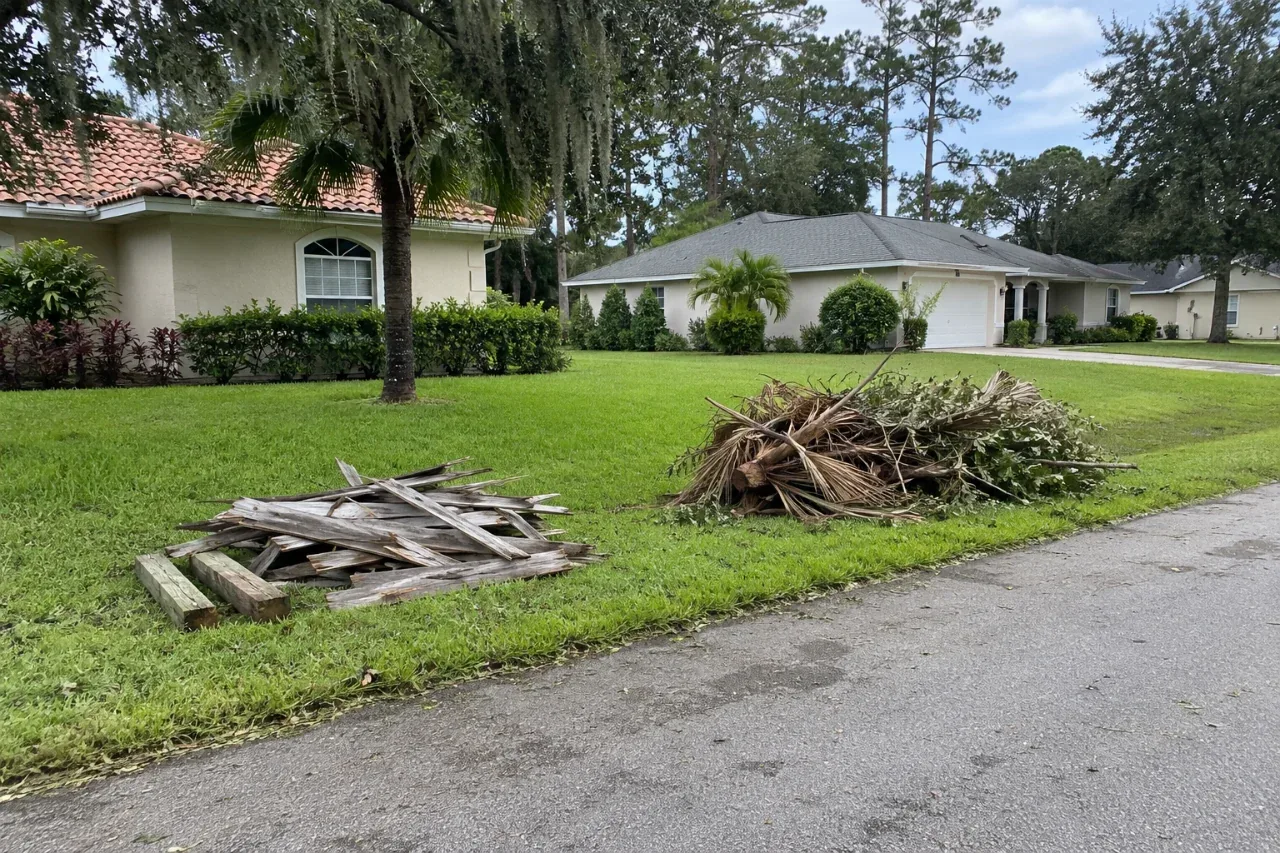
For debris, the city's October 11, 2024 notice asked residents to sort storm debris into vegetative debris and construction and demolition debris, such as lumber; keep piles on their own property at the curb, out of swales and ditches and away from mailboxes and driveways; and skip bags and containers, warning that one plastic bag could cause FEMA to deny an entire pile. Collection was scheduled to start October 16, in a single pass, so a pile that wasn't ready could be missed. Watch the city's notices after the next storm for that year's dates.
Replacing a fence the storm took
A replacement has to meet today's rules, even if the old fence didn't. On a canal lot, an old 6-foot solid fence near the water comes back at 4 feet or as an open style. A silver chain link fence comes back black or bronze. See repair and replacement.
Questions homeowners ask
Will a vinyl or wood privacy fence survive a hurricane?
No source read for this site promises that for any fence. Solid fences catch more wind than open ones, and how the posts are set does most of the work.
Do I need a permit to rebuild my fence after a storm?
Not a building permit. The owner signs the city's acknowledgement for a new or replacement fence.
Where do I put the broken fence?
Follow the city's storm debris notice: construction debris separate from vegetation, at the curb on your property, out of the swale, no bags.
Does insurance cover fences?
That depends on your policy and deductible. Ask your agent first.
How this site helps: your request goes to one independent local fence contractor, who looks at the damage or the new fence line and prices the work. This site does neither.
Related guides
Sources
- National Hurricane Center, tropical cyclone climatology, read November 2026.
- National Weather Service Jacksonville, Hurricane Matthew summary.
- Palm Coast Observer, Matthew damage figures, page dated December 14, 2025.
- Engineering Express, fence design overview, updated April 24, 2025.
- This Old House, how to install a fence post, updated May 22, 2026.
- American Wood Protection Association, residential use categories.
- Florida Department of Financial Services, Florida's hurricane deductible.
- City of Palm Coast, post-storm advisory, October 10, 2024; storm debris removal, October 11, 2024.